It's Saturday, 12:07pm in Frisco. A four-year-old has had a fever since breakfast, the family is new in town, and their regular pediatrician is three states away. The parent doesn't open Google and start comparing. They type one sentence into ChatGPT:
Is there a pediatrician open right now near Frisco?
Whatever comes back next decides where that family goes. Not a page of options — a name, or two. If your practice isn't in that sentence, you were never in the running, and you'll never know the conversation happened.
This is the part most websites haven't noticed. A customer used to type "pediatrician near me" into Google, scan ten blue links, and click one. Increasingly they ask a model — ChatGPT, Perplexity, Gemini, or the AI summary sitting on top of Google's own results — and they get one answer.
Position 4 on a results page still got clicks. There is no position 4 in a sentence.
The question isn't "do I rank." It's "can it read me."
When a model answers a question about your business, it isn't ranking you. It's trying to understand you from whatever it can parse, and then repeating what it understood. If it can't work out your hours, it won't guess — it'll hedge, or it'll name a competitor it could actually read.
Here's the same practice, seen two ways:
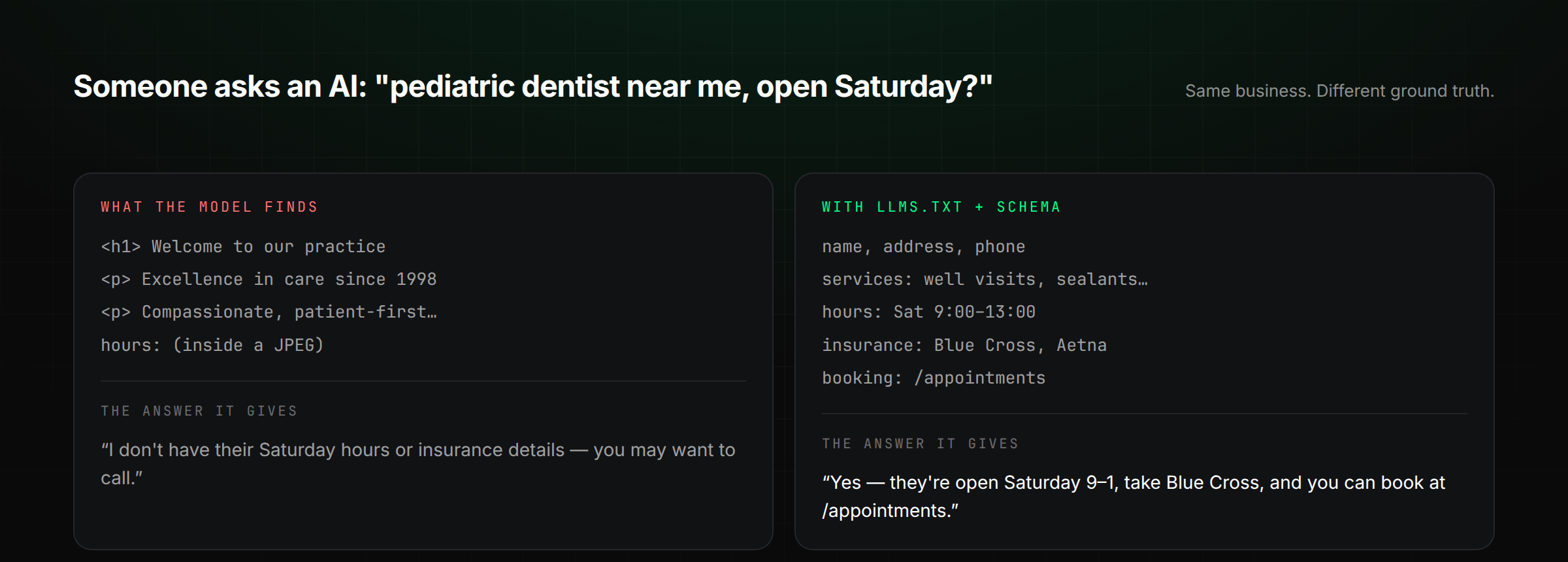
Nothing about the left-hand business is worse. The hours exist — they're just baked into a JPEG, or phrased as "call for availability," or buried in a paragraph about compassionate care. The model isn't being unfair. It genuinely cannot tell.
Beautiful sites are often the least readable
This is the uncomfortable part. The design trends of the last decade — hero images with text baked in, animated section reveals, hours in a graphic, "Our Story" prose that never states a fact — optimized for how a page feels to a human scrolling. Answer engines read structure and plain statements. A gorgeous site can be nearly opaque to them.
Which means the fix isn't to make your site uglier. It's to make sure the facts exist in a form a machine can lift.
What we actually do about it
This is the layer, and it's generated when your site publishes. You don't configure it and you don't buy it as an add-on:
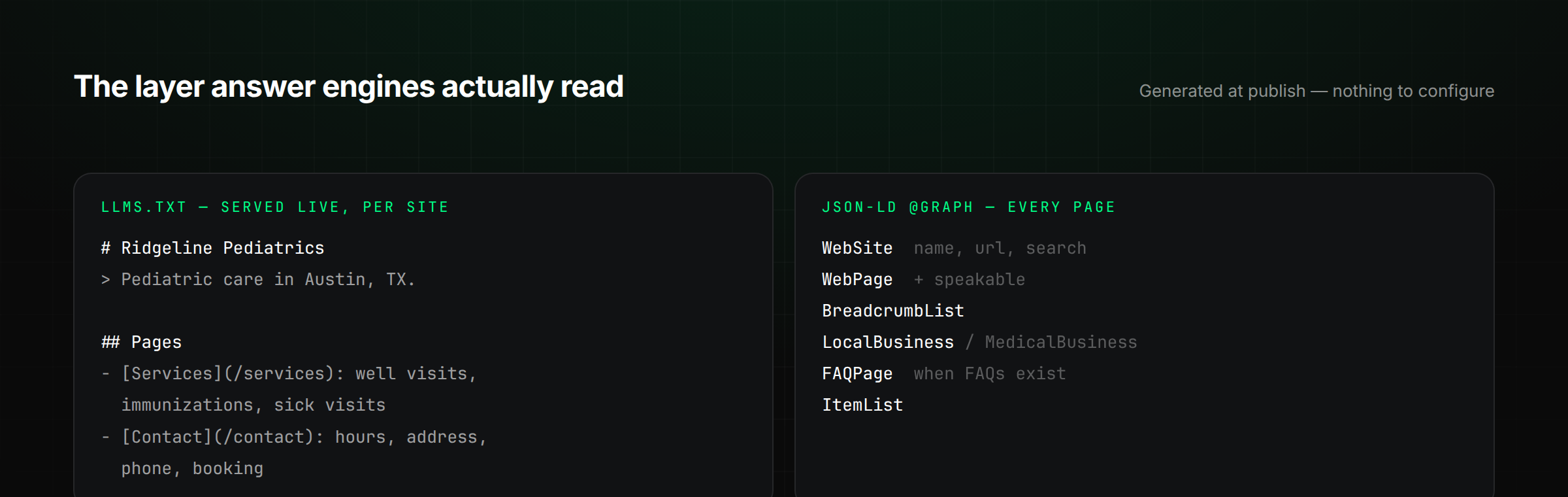
- A per-site
llms.txt— a plain-language map of your business written for models rather than crawlers: what you do, what each page covers, how to reach you. It's live on every published site. - A JSON-LD
@graphon every page —WebSite,WebPagewithspeakable,BreadcrumbList, and the organization type that matches what you actually are (Dentist,MedicalBusiness, orLocalBusiness). - Your opening hours as structured data, day by day, built from your providers' actual schedules —
openingHoursSpecificationwith a realdayOfWeek,opens, andcloses. FAQPagestructured data where you have FAQs on the pages that warrant them — the exact format answer engines lift from.- An AEO pass at generation that writes machine-readable descriptions and FAQs from what you told us — and is explicitly forbidden from inventing your address, prices, or credentials.
- AI crawlers are allowed to read your site rather than blocked.
All of that runs automatically, before your site goes live.
Back to Saturday at 12:07
The hours line is what decides the Frisco question, so it's worth being precise about it.
Most clinic sites put their hours in a graphic, or write "call for availability," or list them in a footer paragraph a human reads fine and a parser shrugs at. Ask a model "are they open right now?" and it has nothing to work with. It won't invent an answer — it'll hedge, or move on to a practice it could read.
When your hours are structured, the model isn't guessing. It can see that Saturday runs 9:00 to 13:00, that 12:07 falls inside that, and answer the actual question:
Yes — Ridgeline Pediatrics in Frisco is open until 1pm today. You can book at ridgelinepeds.com/appointments.
One honest boundary: what's published is your opening hours, not your live slot list. We deliberately don't bake "12:30 is free" into a page. A cacheable page can't promise a specific time — that slot may be gone thirty seconds later, and sending a family across town for an opening that closed is worse than saying nothing. Days and hours are stable and true; live slots stay where they belong, in the booking flow that checks them in real time.
That's the honest version of "AI refers you." Not a ranking you bought. Just being the practice whose hours the machine could actually read at 12:07 on a Saturday.
Two things we won't tell you
Being straight, because this corner of the market has gotten loud and dishonest fast:
Nobody can guarantee you a spot in a ChatGPT answer. Not us, not an agency charging $2,000 a month for "GEO." There is no submission form, no ranking dial, no index you can pay into. Any vendor promising placement is selling certainty that doesn't exist.
Nobody can reliably tell you how often ChatGPT recommended you, either. These systems don't send referral traffic you can cleanly attribute, and they answer differently to different people. We'd rather say that plainly than sell you a dashboard with a confident number on it.
What is within your control is whether the machine reading your business finds clean, structured, accurate ground truth — or has to guess. That's not a growth hack. It's just being legible.
The practical version
Whether or not you use OwnSites, this is the work:
- State facts as text. Hours, address, phone, insurance, services. Not in an image. Not implied.
- Answer real questions in plain language — "Do you take Blue Cross?" as a heading with a direct answer beneath it.
- Be one clear kind of thing. Ambiguity about what you are makes you a bad answer to every question.
- Keep it consistent with your Google Business Profile and directories. Contradictions make a model hedge.
- Don't hide the important part behind a form. If a model can't see it, it can't recommend it.
The businesses that win the next few years of search won't be the ones that gamed a model. They'll be the ones a model could actually read.